In Seasons at Prince Creek West, Build Year Matters As Much As Price
September 24, 2026
September 24, 2026
Picture two listings on Grand Cypress Way, three doors apart. Same three-bedroom layout, same square footage on paper, same HOA fee on the disclosure sheet. Walk into each one and you are standing in homes built nearly a decade apart, under two different builders, with two different sets of construction timelines behind them. None of that shows up in the price. It shows up later, in the roof, the water heater, and the inspection report.
That gap is not a fluke. It is baked into how this neighborhood actually got built, and it is worth understanding before you compare two resale listings that look identical on paper.
Seasons at Prince Creek West broke ground in 2004 under Levitt & Sons. Three years later, on November 9, 2007, the builder filed Chapter 11 bankruptcy, a story local news covered at the time because residents in the still-forming neighborhood suddenly had no clear answer about what would happen to empty lots, homes under construction, or the clubhouse they had been promised. The Seasons project was one of several Levitt & Sons developments across Georgia, South Carolina, and Florida that ended up under bankruptcy administration, a case documented by the accounting firm that handled the wind-down.
Construction sat mostly idle for close to two years while the bankruptcy worked through the courts. Dockstreet Communities acquired the unfinished project in 2009 and kept building for another eight years, closing out construction in 2017.
Add it up and you get a community built across a thirteen-year window under two different builders with a multi-year pause in the middle. That is not how most resale buyers picture a single HOA-governed neighborhood, and it is not how the listings present it either. A listing just says "Seasons at Prince Creek West." It does not say which chapter of that story the home belongs to.
The most visible casualty of the gap was the clubhouse. Early residents who bought under Levitt were living with a modest interim amenity building while the originally planned centerpiece sat unfinished. Dockstreet eventually delivered on that promise, opening a 29,000 square foot Grand Clubhouse in March 2013, complete with a ballroom, card room, media room, and its own indoor pool. For anyone who bought a home in the earliest years of the community, that means roughly half a decade passed between move-in and the amenities that now define the neighborhood's identity.
That timeline matters for a different reason today. It tells you that homes clustered closest to the current clubhouse and amenity core are more likely to be later-era construction, built once Dockstreet had resumed a steady building pace, while homes in some of the outlying sections may trace back further.
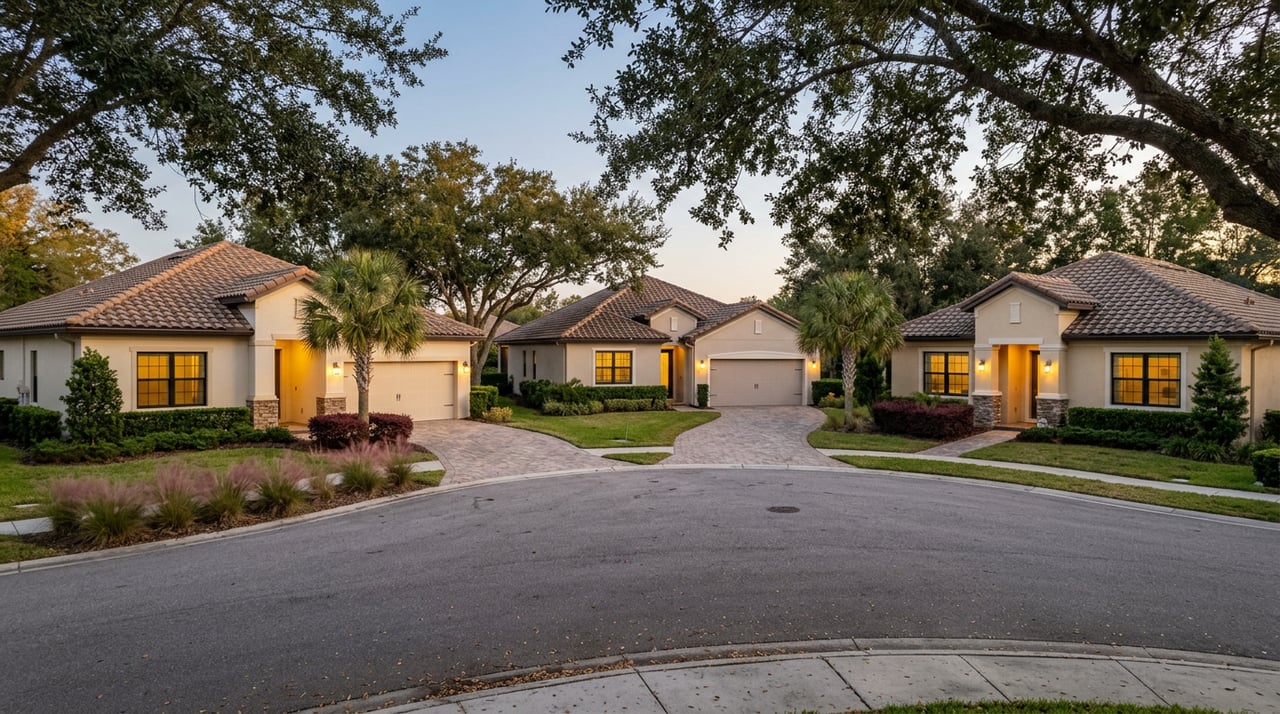
If you spend any time scanning listings in this neighborhood, you will run into two recurring names: the Majestic Series and the Phoenician Series. These are the two product lines Dockstreet used once it resumed building in 2010. Majestic homes run five floor plans, all two bedroom plus den, ranging from about 1,748 to 2,015 square feet. Phoenician homes are larger, a single three bedroom plus den plan between 2,286 and 2,501 square feet.
The handful of homes that trace back to the original Levitt era, built between 2004 and 2007, predate that naming system. Older community descriptions from that period describe two-bedroom, two-bath layouts with an optional third bedroom, a different footprint than what Dockstreet later standardized under the Majestic and Phoenician names. If a listing agent cannot tell you which series a home belongs to, that alone is worth asking about, because it usually means nobody has looked closely at when the home was actually built.
Here is where this stops being trivia and starts affecting your due diligence. Most of the homes in Seasons at Prince Creek West were built between 2010 and 2017 under Dockstreet. That means the bulk of the neighborhood's housing stock is currently somewhere between nine and sixteen years old. A first-generation HVAC system installed in a 2011 build is now old enough to be nearing replacement. A roof from the same year is approaching the tail end of typical asphalt shingle life in a coastal climate.
The smaller cohort of homes built during the original 2004 to 2007 Levitt window is a different story entirely. Those homes are now nineteen to twenty-two years old. Some may already have had a roof or HVAC system replaced once, which can actually work in a buyer's favor if the seller has documentation. Others may still be running original systems well past their expected lifespan.
Neither era is automatically the better buy. What matters is that you ask the question directly. Request the actual year built from the county record, not just the general claim that the home is "in Seasons." Ask the seller for documented replacement dates on the roof, water heater, and HVAC system. Two homes priced within a few thousand dollars of each other can carry very different remaining useful life in their major systems, and that difference is often larger than the difference in finish level or upgrades.
Current dues for the community run approximately $300 to $330 a month, covering internet, weekly trash pickup, lawn service, irrigation, full amenity access including the indoor and outdoor pools, fitness center, and tennis courts, and use of the Grand Clubhouse with its onsite lifestyle director. That figure is actually a step down from the $300 to $400 range that circulated in earlier community materials, which is worth flagging because HOA fees in most 55+ communities move in one direction over time. Confirm the current number directly with the association before you write an offer, since dues can shift with budget cycles, but do not assume the fee only ever goes up here. It has not, at least not recently.
If you are comparing two listings in Seasons at Prince Creek West this season, treat the build year with the same weight you give the price and the floor plan. Ask your agent to pull the county record showing actual year built, not just the neighborhood name. Request seller disclosures that specify replacement dates on major systems rather than general condition statements. If a listing mentions the Majestic or Phoenician series by name, that tells you the home falls within the 2010 to 2017 Dockstreet window. If it does not, ask why, because it may be one of the earlier homes from the neighborhood's first chapter.
None of this makes one era of the community better than another. It makes the difference visible before closing instead of after the inspection.
Are homes from the original Levitt era less desirable than the newer Dockstreet-built homes? Not inherently. Age alone does not determine quality, and some of the earliest homes have already had a full system replacement cycle, which can mean newer components than a home built a decade later that has never been touched. What matters is documentation, not the builder's name on the original permit.
How do I find out which builder or year actually built a specific home? Horry County property records list the construction year for any parcel, and your agent can pull that alongside the listing history. It takes a few minutes and settles the question definitively.
Does the HOA fee differ between the older and newer sections of the neighborhood? No. The current fee, approximately $300 to $330 a month, applies community-wide through the single homeowners association, regardless of which builder or year constructed the home.
If you are weighing two homes in Seasons at Prince Creek West and want a second set of eyes on build year, floor plan series, and what a seller's disclosure is actually telling you, I am glad to walk through it with you. I have spent years learning this neighborhood section by section, and I would rather you know the difference before you make an offer than after. Reach out to Brendan Danna and let's connect.
Stay up to date on the latest real estate trends.
New Construction
A close look at Chesapeake Homes' Bridgewater community — collections, HOA, lake-view lots, and what it actually feels like to live fifteen minutes from Cherry Grove B… Read more
Get assistance on determining current property value, crafting a competitive offer, writing and negotiating a contract, and much more. Let me guide you through your home-buying journey.

ADDRESS 1297 Professional Dr Ste 201 Myrtle Beach SC 29577