Buying in Myrtle Trace Conway HOA: Questions to Ask
August 13, 2026
August 13, 2026
Ask a closing attorney anywhere else in the Grand Strand how long it takes to get a resale certificate, and the answer is usually the same: log into the management company's portal, pay the processing fee, wait a few business days. Ask about a home in Myrtle Trace, and the answer changes, because there is no portal and no management company. There is a five-person volunteer board, elected by the residents for three-year terms, handling the request themselves.
That difference is not a paperwork inconvenience to shrug off. It is the actual reason Myrtle Trace's HOA fee is one of the lowest in the Grand Strand's 55+ market, and it changes what a buyer should ask for before writing an offer.
Myrtle Trace's own association describes itself plainly: it is a self-managed community relying primarily on unpaid volunteers, and as a direct result, the homeowners fee runs about $90 a month. Compare that to Tuscany in Myrtle Beach, another gated 55+ community in the same market, where quarterly billing works out to roughly $312 a month. The gap is not about better amenities at Tuscany. It is about who is doing the work of running the association.
At Myrtle Trace, that work falls to a five-member Board of Directors and four standing committees: Property, Architectural Review, Activities, and Communications. No professional manager tracks vendor contracts, prepares monthly financials, or fields resale certificate requests on a fixed schedule. Volunteers do it, on top of their own retirements, and the low fee reflects the absence of a management company's overhead, not necessarily a difference in the underlying cost of running the community.
Here is the part most buyers do not expect. South Carolina does not require homeowners associations to complete a reserve study by law. The current Homeowners Association Act, in place since 2018, encourages boards to keep adequate reserves but does not mandate it. That matters more in a self-managed community than a professionally managed one, because a management company typically builds reserve tracking into its standard service. A volunteer board is not required to, and there is no outside party checking their work.
This was almost changed. A bill introduced in the South Carolina House in February 2026, H. 5204, would have required existing associations to reach a fully funded reserve account by January 2037, with reserve studies every three years going forward. Community association advocates opposed the bill as overly broad, and it died in committee before the session ended. For now, the law stays as it was: reserve funding in South Carolina is a matter of board discipline, not statutory requirement.
For a buyer looking at Myrtle Trace, that means the honest question is not "can I see the reserve study," treated as a formality every association has on file. It is "does one exist at all, and if so, when was it last updated." A self-managed board with a three-year election cycle and no professional oversight may be diligent about this. It may not be. The only way to know is to ask directly and in writing.
Myrtle Trace's governing documents include a Certified Statement of Assessments, the document a seller or buyer requests to confirm dues are current before closing. It is useful, and it is also limited in what it tells you.
| What it typically shows | What it typically does not show |
|---|---|
| Whether the seller's account is current | The community's reserve fund balance or funding target |
| Outstanding fines or violations tied to the property | Whether a reserve study has ever been performed |
| Current monthly assessment amount | Planned capital projects, like roof or road resurfacing timelines |
South Carolina law does give buyers a separate right that helps close some of that gap. Under the Homeowners Association Act, any lot owner can request to inspect the association's books and records, and the association has to make them available within a set window. For a self-managed board without a portal, that request may need to go directly to a board member rather than through an automated system, so it is worth asking early rather than assuming the paperwork will arrive on the same timeline as a professionally managed community.
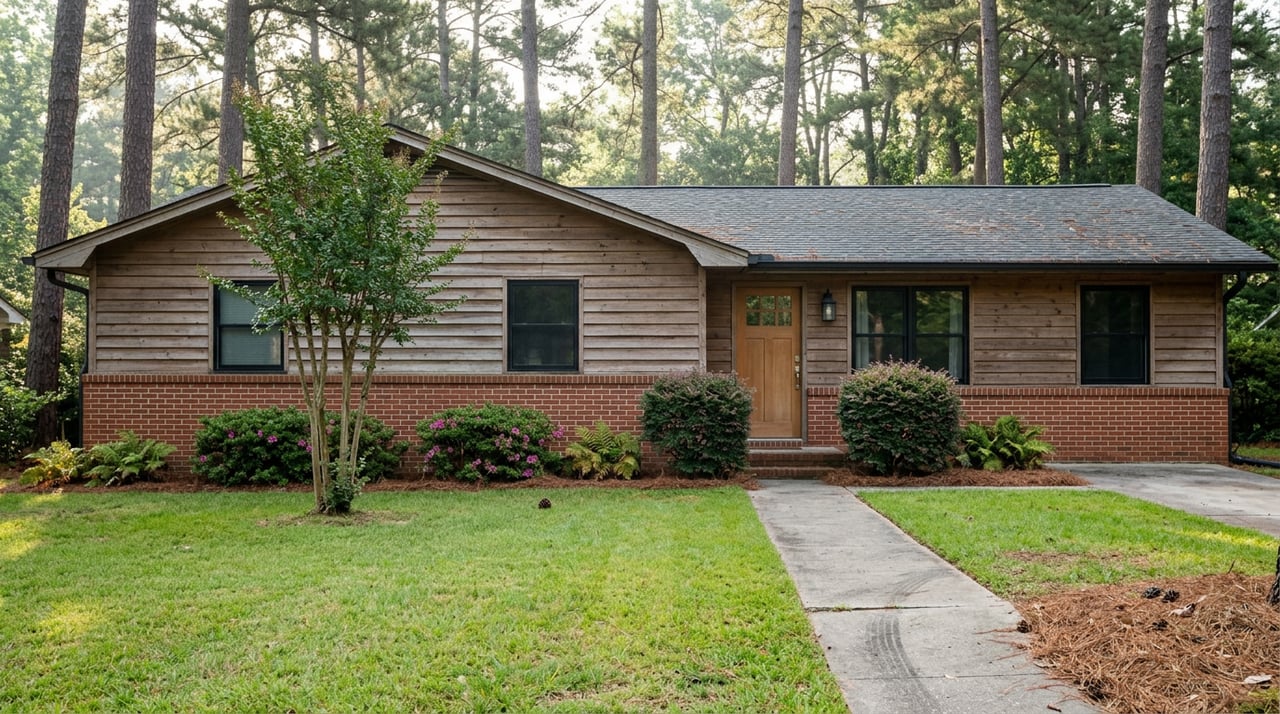
Myrtle Trace was built in eight phases by Hall Development Corporation, starting with Phase I in the early 1980s and finishing with Phase VIII, 114 homes, in 2005. The siding changed partway through: Phases I through VII were built with cedar siding and a brick facade, while Phase VIII switched to vinyl.
That construction timeline is not just a historical detail. It shows up directly in insurance quotes. Coastal South Carolina insurers commonly price homes built before 2000, or with roofs older than 15 years, in the $4,000 to $6,500-plus annual range, compared with roughly $1,800 to $3,000 for homes built in 2000 or later with updated systems. A Myrtle Trace home from Phase I is now more than 40 years old. That does not mean every early-phase home carries a high premium. Roof age, updated wiring, and prior claims history all factor in. It does mean a buyer comparing two homes in Myrtle Trace by price alone, without asking which phase and when the roof was last replaced, is missing a real cost difference that will show up in the first insurance quote.
Buyers researching Myrtle Trace should also confirm which association actually governs the specific address. Myrtle Trace South is a separate homeowners association covering 149 single-family homes, with its own board and its own clubhouse, distinct from the original Myrtle Trace community. The two share a name and a general location between Conway and Myrtle Beach, but they are not interchangeable when it comes to covenants, fees, or the documents a closing attorney needs to request.
Does Myrtle Trace have a property management company? No. The community is self-managed by an elected volunteer board and resident committees rather than an outside management firm.
Is South Carolina about to require reserve studies? Not currently. A bill that would have phased in mandatory reserve funding by 2037 died in committee in 2026. Boards can still choose to run reserve studies voluntarily, but nothing in state law requires it.
Are Myrtle Trace and Myrtle Trace South the same HOA? No. They are separate associations with separate governing documents, even though both sit in the same general area between Conway and Myrtle Beach.
Why does the low HOA fee matter for my purchase decision? It is not a red flag on its own. It reflects a genuinely different operating model. The question worth answering before closing is whether that model has kept up with long-term maintenance planning, not just monthly bill collection.
A low HOA fee and a self-managed board are not a warning sign. They are a different way of running a community, and one that has kept Myrtle Trace among the more affordable 55+ options on the Grand Strand for decades. Understanding how it actually works, rather than assuming it operates like a professionally managed community down the road, is what makes the difference between a smooth closing and a surprise a year in.
If you are weighing a home in Myrtle Trace or comparing it against other Grand Strand 55+ communities, Brendan Danna has spent years walking these specific neighborhoods and reading their governing documents. Let's Connect to talk through what a particular address actually comes with before you write an offer.
Stay up to date on the latest real estate trends.
New Construction
A close look at Chesapeake Homes' Bridgewater community — collections, HOA, lake-view lots, and what it actually feels like to live fifteen minutes from Cherry Grove B… Read more
Lifestyle
ShrimpFest dates, new spots that opened in 2026, and how Bridgewater residents are actually using the waterfront this fall.
Get assistance on determining current property value, crafting a competitive offer, writing and negotiating a contract, and much more. Let me guide you through your home-buying journey.

ADDRESS 1297 Professional Dr Ste 201 Myrtle Beach SC 29577